
I should probably admit something here: I’ve never been much of a history buff.
Dates and names on a page don’t automatically grab me. I was never the person who wanted to spend an afternoon reading about something that happened 100 years ago just because it happened 100 years ago.
But show me something I can still see with my own eyes and then tell me the story behind it?
Now you have me.
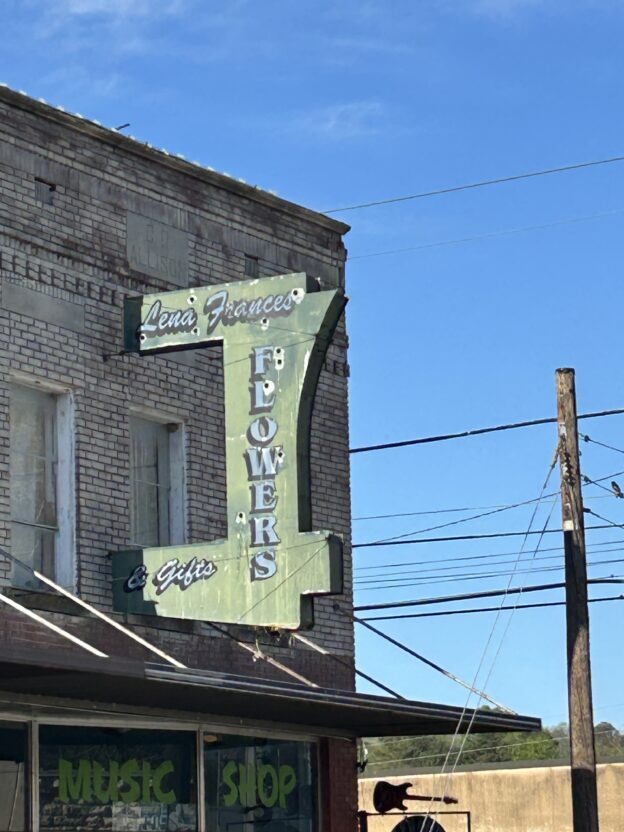
Show me the faded letters painted on the side of a building. Show me the person painted into a mural and tell me who he was. Show me an architectural detail I’ve walked past without noticing. Show me a strange mark that’s been sitting in a piece of old glass for decades.
That’s when history becomes fascinating to me.
Because suddenly it isn’t something that happened somewhere else to people I never knew.
It happened right here.
And some piece of it is still here for us to see.
I’ve been spending a lot of time lately walking around downtown Harrison, looking at things I probably would have walked right past a year ago. And now I find myself constantly asking questions.
What used to be here?
Why does that building look like that?
What are those faded letters?
Who is that person in the mural?
Why did everybody call that intersection Deadman’s Corner?
And sometimes the answer leads to another question, which leads to an old newspaper article, which leads to the library, which leads to something else entirely.
This is what I do now.
For a time, I worked as a hyperlocal reporter in Tulsa. That experience taught me a lot about writing for the public.
You rarely get unlimited space or unlimited attention. You figure out what the story is. You verify what you can. You give people the context they need to understand it. You choose your words carefully. And then you tell the story in a form people will actually read.
A Facebook post is not a newspaper investigation. A caption is not a history book. Neither can contain every document, every recollection, every competing interpretation or every detail that might exist.
Brevity requires choices.
But brevity doesn’t excuse carelessness.
And not every story is a happy one.
History doesn’t work that way.
People built businesses and raised families. They served in public office and created things that lasted. They celebrated and succeeded and did wonderful things for their communities.
They also fought. Businesses failed. Buildings burned. Floods came. People made mistakes. People died. Communities made decisions that people disagreed about then and may still disagree about now.
All of that happened.
Preserving history can’t mean preserving only the comfortable parts.
The difficult stories deserve accuracy, context and respect. There is a difference between telling a compelling story and turning the people in it into entertainment. That distinction matters to me.
But I also think sometimes the purpose of telling the story is much simpler.
It’s to make somebody look.
Look up.
Look at the old sign.
Look at the person painted into the mural.
Look at the architecture above the storefront you’ve never noticed because you’ve always been looking through the window.
Look at the strange mark in a piece of old glass and wonder why it’s there.
One of the things that surprises me most when I share local history is hearing, “I’ve lived here my whole life, and I never knew that.”
I hear some version of that all the time.
Those words remind me how easily history can disappear.
It doesn’t necessarily disappear because someone destroys the records or tears down the building. Sometimes it disappears much more quietly.
One generation knows the story.
The next has heard pieces of it.
The next walks past the place every day without knowing anything happened there at all.
Until somebody tells the story again.
And once you know the story, you see the place differently.
That alley isn’t just a shortcut anymore.
That faded paint isn’t just something nobody bothered to cover.
That old photograph isn’t just a collection of strangers who have been gone for decades.
They were here.
They stood where we stand. They worried about their businesses. They complained about the weather. They celebrated. They grieved. They disagreed about what their community should become. They watched buildings go up and buildings come down.
Eventually, they left the place to us.
Now we get to decide what we remember.
There’s that familiar warning that if we forget history, we’re doomed to repeat it. I’m sure there’s truth in that.
But I think there’s another, quieter danger with local history.
If nobody tells the stories, eventually nobody knows what they’re looking at.
The mural becomes just a mural.
The ghost sign becomes some old paint.
The old photograph loses all of its names.
The damaged glass is simply damaged glass.
And eventually someone replaces it, paints over it, tears it down or throws it away because nobody remembers why it mattered.
So I’ll keep asking questions.
Who was that?
What used to be here?
Why does that look like that?
What happened on this corner?
And when I find the answer, I’ll probably tell somebody.
Because someone has to remember